
Common Brake Systems
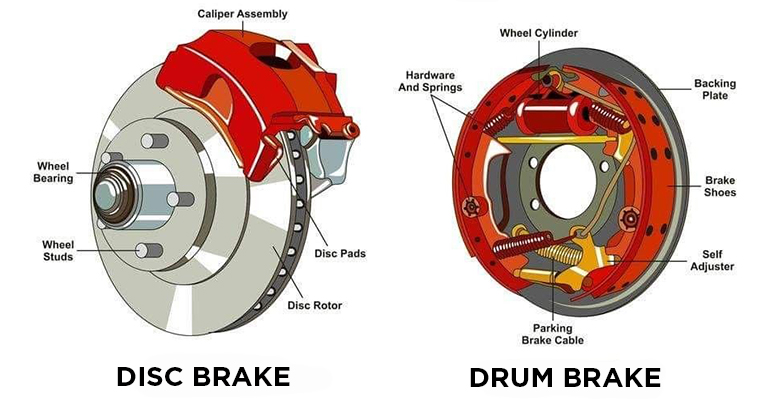
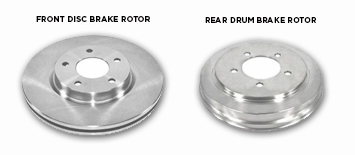
Front disc/rear drum – Small, compact vehicles with less kinetic energy to convert into heat during stopping; light trucks where economy or simplicity of parking brake operation is desired.
Front vented rotor/rear solid rotor – Larger passenger vehicles; mini vans where extreme braking conditions are not commonly encountered.
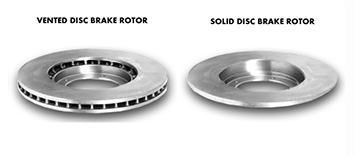
Front and rear vented rotors – high performance sports cars, large passenger cars, or vehicles commonly subjected to heavy breaking conditions.
Generally speaking, larger/heavier vehicles and high-performance vehicles will have larger brake systems and hence will have more weight. Larger rotors are needed so there is a larger friction area between pad and rotor, and to absorb the greater amount of heat generated when converting kinetic energy into thermal energy while braking. Vehicles used for towing should also have enhanced/larger brake systems. While trailers over a certain size do have their own brakes, they do not stop all the trailer’s weight. The difference is picked up by the vehicle’s barking system. Similarly, we must consider vehicles that can vary substantially in the weight they’re carrying. These most commonly include pickup trucks and large passenger vans with capacities up to 18 people. Their brake systems must be designed to work effectively with the maximum possible load.
Rotor types by vehicle type
For most passenger cars and light trucks, solid or vented smooth face rotors are by far the most commonly applied rotor types. Their larger surface areas readily absorb heat, minimize pad pressure for longer life, and exhibit more even wear over time. They are also less expensive to replace.
On sports cars and where high-performance brakes are desirable and economy is a lesser factor, drilled or slotted rotors are commonly used. They dissipate heat faster under extreme braking conditions to reduce brake fade and also shed water better for enhanced pad/rotor contact under wet driving conditions. With these advantages come some disadvantages such as shorter pad life, susceptibility to uneven wear, and in the case of drilled rotors, a greater likelihood they’ll crack around the outer edge under prolonged extreme braking conditions.