
Common Issues
Scoring
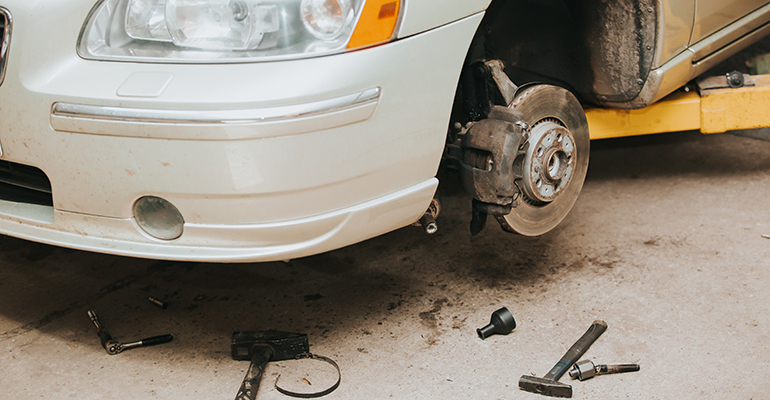
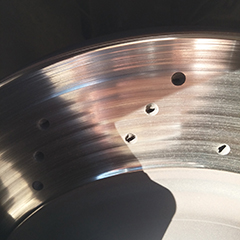
Scoring occurs when brake pads are worn out and the pad’s steel backing plate or rivets rub on the disc’s wear surface. If the scoring is not excessive, the rotor can be repaired with resurfacing in a specially designed brake lathe, although this can only be performed down to the disc’s minimum-rated safe thickness. This minimum thickness value is typically cast into the disc.
Cracking
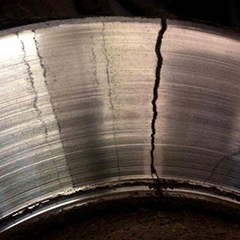
Cracking occurs mostly on drilled discs where small cracks develop around the holes near the edge caused by uneven expansion under severe duty. While hairline cracks may appear in a drilled disc as a normal wear mechanism, catastrophic failure will occur in severe cases. There is no repair for cracks and in severe cases, the disc must be replaced.
Excessive Rust
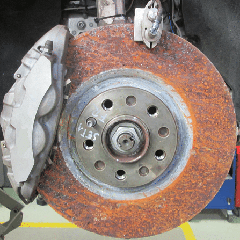
The cast iron from which discs are commonly made will accumulate a certain amount of surface rust, which is normal. The disc contact area will be kept clean by regular use and other surfaces may be kept rust-free if manufactured with special coatings. Some rotors are available with a coating on the non-contact surfaces to prevent rust and help ensure rust is not a cause of reduced brake performance.
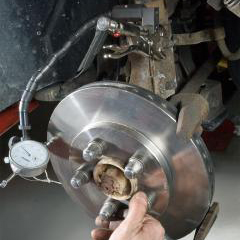
Runout
Runout is measured from about 1⁄2 in (12.7 mm) from the disc’s outside diameter. As the disc is spun, the minimum and maximum value difference is the lateral runout. Runout results from disc deformation, by the wheel hub face, or by contamination between the disc and hub. The thickness variation in discs can be machined out on a brake lathe, provided minimum thickness specifications are not exceeded.
Symptoms of bad rotors
The following symptoms indicate your rotors need inspecting and servicing, if necessary:
• Squealing while braking
• Vehicle pulls to one side while braking
• Vehicle shudders/vibrates while braking
• Brake pedal pulsates while braking
• Brake fade under normal braking
When to replace brake rotors
• Always replace rotors when they reach their specified minimum thickness
• When cracks appear (drilled rotors) that threaten rotor strength/integrity
• When scoring is too deep to be safely machined out
• When excessive runout cannot be corrected with machining and still be within the specified minimum thickness
• Excessive rust that compromises rotor strength or the ability to dissipate heat efficiently
Benefits of installing new rotors with every brake job
Some vehicle owners like to have their rotors replaced when it’s time to install new brake pads. While this isn’t really necessary, as rotors can be turned to eliminate brake pedal pulsation, runout issues, remove grooves, and restore friction area smoothness, there is something to favoring this practice – economy allowing.
First is there shouldn’t be any increase in service time and maybe a time savings. The vehicle’s on the rack and if the rotors need turning, it’s faster to replace rotors than to turn them. Especially if there’s only one brake lathe in the shop.
Secondly, the pads are new, so shouldn’t the rotors be, too? This way, friction material and friction surface are brought back to like-new vehicle condition, ensuring maximum brake system performance. This is especially true as turned rotors have less material and will tend to run hotter under heavy braking, making them more susceptible to brake fade.
Should a reinstalled rotor have an undetected underlying issue (nascent hard spots, unseen cracks or insufficient thickness), performance problems may emerge that will require getting the vehicle back on the rack for servicing.
Replacing the rotors with every brake job, while more expensive, is the most sure way to get the same level of brake performance as when the vehicle was new.